Forest Economics
September 23, 2026
Gary’s Blog, September 17, 2026
A fortunate one
One of the absolute gifts I’ve received over the years is being able to teach field courses on Ecological Forestry at both UPEI and Acadia University. I’ve always had lots of young, bright people around me and never really worried about the quality of future generations. This view is constantly reinforced with each new batch of students taking these classes.
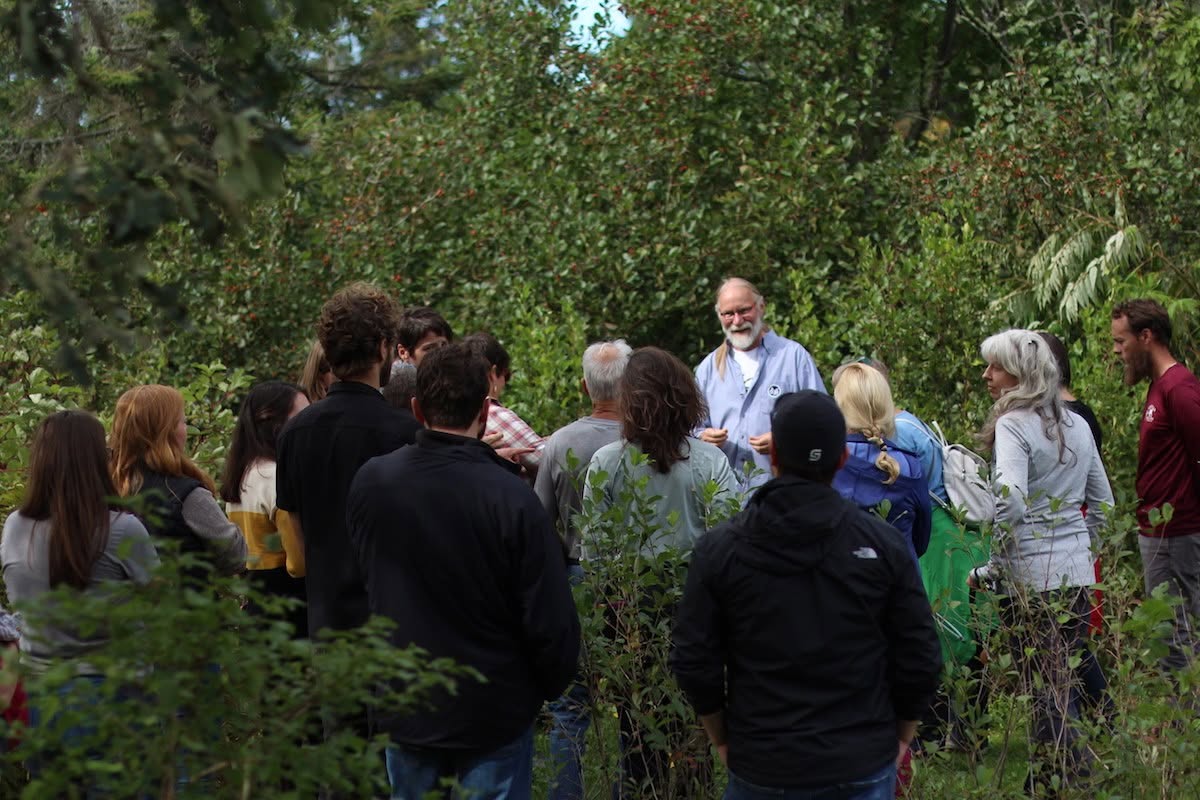
The UPEI course takes place entirely at Macphail Woods. Some students are taking Environmental Studies or Biology, while others can be studying to be paramedics, accountants, or Kinesiologists. It is really a treat to have students from so many disciplines.
Some have lived and worked in the Wabanaki forest, while others have recently arrived from Nigeria or Sri Lanka.
The course is an intensive week of learning, most of which is outdoors. And there is a Reflection Paper that has to be completed as the final component. The UPEI course takes place early in June, while the Acadia course is always the last week before the new semester starts in September.
There can be challenges with the timing of both courses – too buggy, too wet, too hot. But looking back on over 20 courses, they’ve all be so rewarding to teach. The students are often afraid of not being able to learn quickly enough. We have an identification quiz on Tuesday and then one on the Friday and it is amazing to see how much people can learn. And not just about identification, but about where species thrive, what types of wildlife make use of them, and where each fits into forest restoration.
In her final paper, one of the students wrote:
“Now I understand that the quality of the relationships matters. Habitat, interactions, food sources, structure, and ecological roles are part of biodiversity. A healthy forest needs more than a checklist of species.”
Instead of just learning how to identify plants from looking at pictures or even leaf samples, the class is constantly tromping through Macphail Woods or the Harriet Irving Botanical Garden to study plants in at least a somewhat natural habitat. We try to understand topics such as natural succession, and why an awareness of light and soil conditions is so critical when making decisions on forest restoration.
The course is modelled on experiential learning, pioneered by John Dewey, which takes place “when a person involved in an activity looks back and evaluates it, determines what was useful or important to remember, and uses this information to perform another activity.” It is very much a hands-on course. Students are encouraged to use all their senses when learning about plants – the strong smell of bayberry and balsam fir, the
textures of sumac twigs and elm leaves, the taste of chokecherry and common elder. The sensory experiences helps to trigger remembrance of different species.
Another student offered this insight on facing a different way of learning:
“Overall, this course has changed the way I look at forests, but it has also changed the way I look at myself as a student. I learned that I can learn through experience, that I can critically think through problems, and that I can understand complex relationships when I take the time to slow down and notice them. At the beginning of the week, I looked around the forest and saw trees. At the end of the week, I looked around and saw relationships, history, habitat, and life. I think that is probably the biggest change that happened to me throughout these five days.”
I often feel as though I learn more from the students than I teach. And from the woodlot owners as well. Perhaps that is the real blessing of what I do.